

The Real Cost of Kajabi vs ThriveCart 2026
February 6, 2026
Since Kajabi announced its price increase, we’ve had the same question come up again and again from clients and online course creators:
“Is it time to move?”
Costs are going up everywhere. And with Kajabi’s monthly plans starting at $143, it naturally makes business owners pause and ask whether it’s still earning its keep.
That’s really where the ThriveCart vs Kajabi question is coming from. Not because one is ‘better’, but because margins matter more than they used to.
Over the past few months, we’ve helped several clients take a proper look at their setup and, in a lot of cases, move from Kajabi to ThriveCart because it fits where their business is now.
This isn’t just a feature-for-feature comparison. It’s a deep dive into how we’ve helped our clients make the decision through a systems and cost lens.
The First (And Most Important) Question: How Do You Want To Run Your Business?
Before you compare features or pricing structure, there’s a more important question to answer in the ThriveCart vs Kajabi debate:
How do you actually want your business to be set up day to day?
Because once you’re clear on that, the rest of the comparison usually sorts itself out.
Some founders want one platform that does everything. One login. One place to go. One bill to pay. That’s where an all-in-one platform like Kajabi makes more sense. You’re paying for simplicity and fewer decisions, and for some businesses, that’s worth it.
Others are already past that stage.
They’ve already got:
- a website they’re happy with
- email marketing set up and working
In that case, you’re paying a premium for an all-in-one platform just to host a course or membership often stops making sense. You’re not buying simplicity anymore. You’re paying for features you’re not using.
That’s where a leaner setup using ThriveCart can be the more practical option. It doesn’t try to replace your website or your email platform. It just does one job well – taking payments and maximising each sale.
So instead of asking, “Which platform is better?”
The more useful question is:
Do you want one platform and are you happy to pay for that privilege? Or do you already have systems that work and just need a stronger, more cost-effective checkout?
Once you answer that, the decision usually becomes pretty clear.
The Financial Reality: Lifetime Deal vs. Monthly Subscriptions
Pricing is usually the deciding factor in the ThriveCart vs Kajabi conversation.
For a lot of people already using Kajabi, the recent price increase is what’s prompted the reassessment. Because in the current economy, those pricey monthly subscriptions feel heavier than they used to.
Fixed costs are under more scrutiny. And for a small business owner, that matters.
A monthly plan doesn’t flex with your business model.
A subscription doesn’t pause just because revenue does.
It’s there when:
- you’re between launches
- you’re rebuilding an offer
- you take time off
- a quarter is slower than expected
That pressure adds up and it has a real impact on budget, decision-making, and return on investment.
Breaking down the Kajabi premium
Kajabi is priced as an all-in-one platform and to be fair, it does that job well.
But for most established businesses, you’re realistically looking at the Growth plan to remove branding and unlock automation. At current pricing, that’s around $249 per month, or roughly $2,988 per year.
That total cost exists before:
- a single sale is made
- an online course or membership launches
- a digital product proves itself
Kajabi often highlights its zero transaction fees, and that sounds appealing. In practice, transaction fees are rarely the issue. The bigger factor is the fixed monthly commitment (even when revenue is quiet).
A slow month on ThriveCart costs you nothing in platform fees.
A slow month on Kajabi still costs you a few hundred dollars.
Over time, that gap has a noticeable impact on cash flow and ROI.
ThriveCart’s real costs
ThriveCart’s lifetime deal* (a one-time payment) usually raises an eyebrow. And that’s fair. It sounds almost too good to be true.
The important thing is understanding what ThriveCart is (and isn’t).
It’s a checkout and sales platform. It’s not trying to replace your website, email marketing, or video hosting.
So a realistic ThriveCart setup usually includes:
- an email platform (MailerLite $100per year or Kit $300 per year for most businesses)
- external video hosting if you’re running courses (YouTube – FREE or Vimeo $10pm)
- a website probably you already have in place
At a minimum.
That isn’t necessarily a downside but it is part of the true cost, and it’s something we’re always clear about.
ThriveCart vs Kajabi: cost breakdown
Here’s the comparison we typically walk clients through:
| Cost Item | Kajabi (Growth) | ThriveCart Stack* | ThriveCart Learn+ |
| Upfront Cost | $0 | ~$495 (One-time) | ~$495 (One-time cost for standard)~$195 (plus one-time cost for upgraded features) |
| Monthly Cost | $249 | ~$65 (Email + Video +Webiste)* | ~$65 (Email + Video +Webiste)* |
| Month 1 Total | $249 | $560 | $775 |
| Month 12 Total | $2,988 | $1,275 | $1,470 |
| Month 24 Total | $5,976 | $2,815 | $2,250 |
*Stack Estimate: Mailerlite growing business up to 1,000 subs ($9/mo) + Vimeo Video (~$12/mo) + Website & Hosting $35.
It’s also worth mentioning that some of the clients we’ve helped to switch platforms were already paying for a website on top of Kajabi. It wasn’t a new cost for them. With that in min,d the break-even point actually comes much sooner.
Yes the upfront cost is higher with the ThriveCart lifetime deal. But within a few months, it’s paid for itself. The ongoing costs stay low, the pressure drops, and you keep more control over your budget.
ThriveCart vs Kajabi: Checkout Experience
This often gets overlooked. But if you’re selling online courses, memberships, or digital products, the checkout experience matters more than most people expect.
For two reasons.
First, it’s where the sale is either closed or lost.
All the work in your sales funnels and conversion funnels leads here. If the checkout feels clunky, confusing, or limited, that effort is wasted.
Second, it’s where sales funnel optimisation actually happens.
This is the point where you can add:
- order bumps
- upsells and downsells
- simple funnel improvements
- A/B testing to increase conversion without increasing traffic
For very simple offers, Kajabi does the job. The checkout is clean, it works, and it fits neatly inside an all-in-one system. If you’re selling a single product with no extras, that may be enough.
Where we see businesses outgrow it is when they want more control, without rebuilding their site or reworking everything else.
That’s where ThriveCart tends to make more sense. It’s built around checkout optimisation, not just payments. Flexible checkouts, conversion-focused funnels, and built-in A/B testing are the core of the platform, not an add-on.
And for businesses that are already getting traffic, improving that final step can make a bigger difference than almost anything else.
Checkout & Sales Funnel Optimisation Comparision
Rather than explaining this at length, it’s easier to see the difference side by side.
| Feature | ThriveCart | Kajabi |
| Core focus | Conversion-driven platform built around sales performance | Brand-first, all-in-one platform |
| Checkout pages | Highly customisable, designed for high converting checkouts | Clean, consistent, but more rigid |
| Order bumps / bump offers | Prominent and flexible, designed to increase AOV | Basic checkbox-style implementation |
| Upsells & downsells | Native support for multi-step upsells and downsells | Limited functionality |
| Sales & conversion funnels | Built for optimised funnels and complex paths | More linear funnel structure |
| A/B testing | Built-in testing for checkout pages and offers | Not available natively |
| Physical products | Native shipping rules and fulfilment support | Requires workarounds |
ThriveCart Learn vs Kajabi: Course Hosting & Learning Experience
This is where the ThriveCart vs Kajabi conversation often becomes less technical and more personal because it’s tied to the learning experience.
Kajabi is a strong online course platform.
As a course builder, it’s polished and comprehensive. Everything is built in: video hosting, structured lessons and modules, course templates, drip content, and a mobile-friendly student environment. For membership sites, communities, or content-heavy programmes, that cohesion can really matter. It simplifies course creation and reduces friction for both the founder and the student.
Where we see clients pause is when they realise they’re paying for that polish, even when their offer doesn’t actually rely on it.
For many of the businesses we work with, the course or membership isn’t the product. It supports the product – usually coaching and services, or a broader programme. And that distinction changes the decision.
When Kajabi’s course experience earns its keep
Kajabi usually makes sense when:
- students log in regularly
- content is drip-fed or community-led
- the learning environment itself is part of the value
- you want content hosting, email, courses, payments, and communities handled in one place
In those cases, the higher monthly cost can be justified because the platform experience is part of what customers are buying.
ThriveCart Learn: a simpler course builder by design
ThriveCart Learn approaches course hosting differently.
It isn’t trying to compete with Kajabi on polish or complex course layouts. It’s designed to deliver content reliably, without locking you into a high ongoing platform cost.
For many of our clients, that’s exactly what they need.
ThriveCart Learn works well for:
- courses that support coaching and services
- memberships where implementation matters more than content volume
- digital products with downloadable content
- offers that don’t require daily logins or complex course templates
- businesses prioritising margin over a premium learning environment
One of the biggest differences to understand here is video hosting.
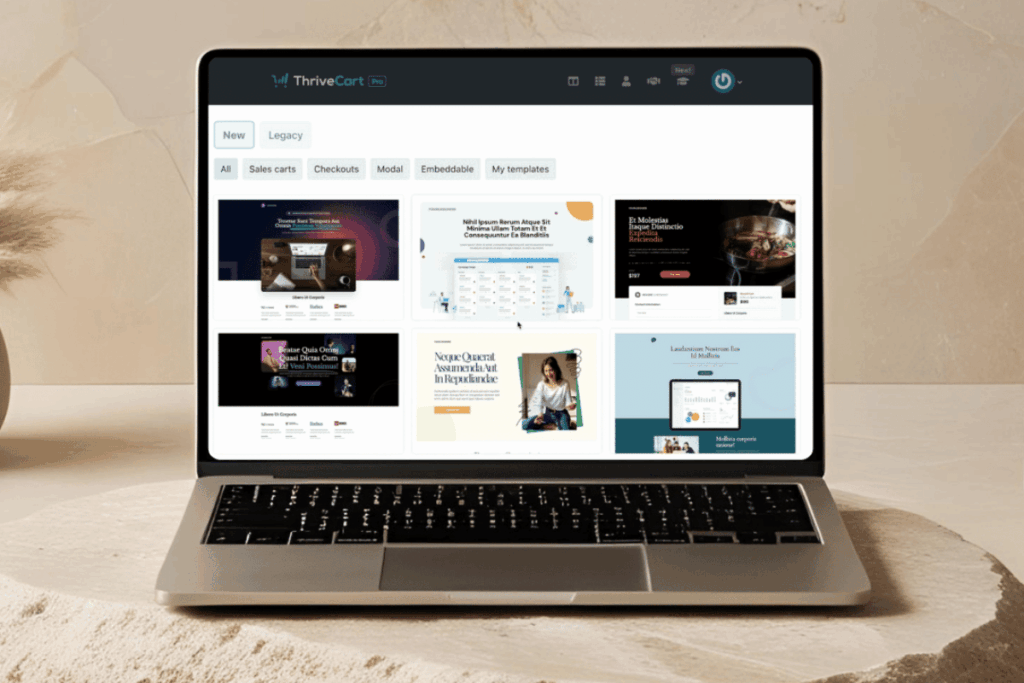
ThriveCart doesn’t host videos natively. Instead, videos are embedded from an external platform. In practice, most of our clients already use YouTube or Vimeo for content hosting, so this rarely becomes an issue, but it is something to be aware of during setup.
Which platform is better for hosting online courses and memberships?
This usually comes down to one question…
Is the learning environment the product, or is it there to support the product?
If the course platform itself is a selling point, Kajabi still leads.
If the course or membership exists to support a broader offer, ThriveCart Learn is often the more practical option – especially when paired with lower ongoing costs and a stronger checkout experience.
Kajabi vs ThriveCart: Email Marketing
Email marketing matters for most small businesses – especially if you’re selling online courses, memberships, or digital products.
Most of the businesses we work with don’t have the need for advanced email marketing tools. They just need something they can use consistentl,y and that fits with how their business runs.
Kajabi’s built-in email marketing
Kajabi’s built-in email marketing is genuinely quite good. It’s one of the reasons people stay.
You can run:
- broadcasts and newsletters
- welcome sequences
- automations tied to behaviour and purchases
- segmentation that works well for most offers
For the majority of business owners and online course creators, Kajabi’s email tools will do the job without needing extra integrations.
Where Kajabi can become limiting is with more advanced needs.
ThriveCart: flexible email options
ThriveCart doesn’t include email marketing, which sounds like a drawback until you realise what it gives you: choice.
For most ThriveCart setups, a platform like MailerLite* is more than enough. It covers the basics properly:
- automation
- segmentation
- lead magnets and sequences
- email-led funnels that support course sales or digital products
But if you’re in a business where you need more advanced functionality (like data unification, omnichannel automation, AI-driven personalisation, and complex segmentation) then you’re realistically looking at a tool like Klaviyo.
If you need advanced features, you’ll be paying for them regardless of whether you’re on Kajabi or ThriveCart. That cost sits outside the ThriveCart vs Kajabi decision, because it’s driven by your email strategy and data needs, not your course platform.
So ThriveCart works well here because you can start sensible (MailerLite), and only move up to something like Klaviyo if and when your business actually needs it, without rebuilding your whole system.
Kajabi vs ThriveCart: Platform Usability
Running a business is hard enough as it is, without adding a course platform to the day-to-day mental load. So how do these stack up?
Kajabi is powerful, but complex.
There’s a lot going on (courses, email marketing, websites, funnels), and that is exactly why many founders hire someone to help manage it. The interface isn’t difficult once you know it, but it isn’t intuitive either.
Kajabi does have solid training resources and customer support, which helps. But for a founder running things themselves, the overall ease of use often feels lower than it should be.
ThriveCart has a learning curve too, especially if you’ve never used a checkout cart or CRM-style tool before. The initial setup takes a bit of focus, particularly around integrations, checkout process, and tax compliance (including sales tax and VAT).
Once that’s done, it’s fairly straightforward.
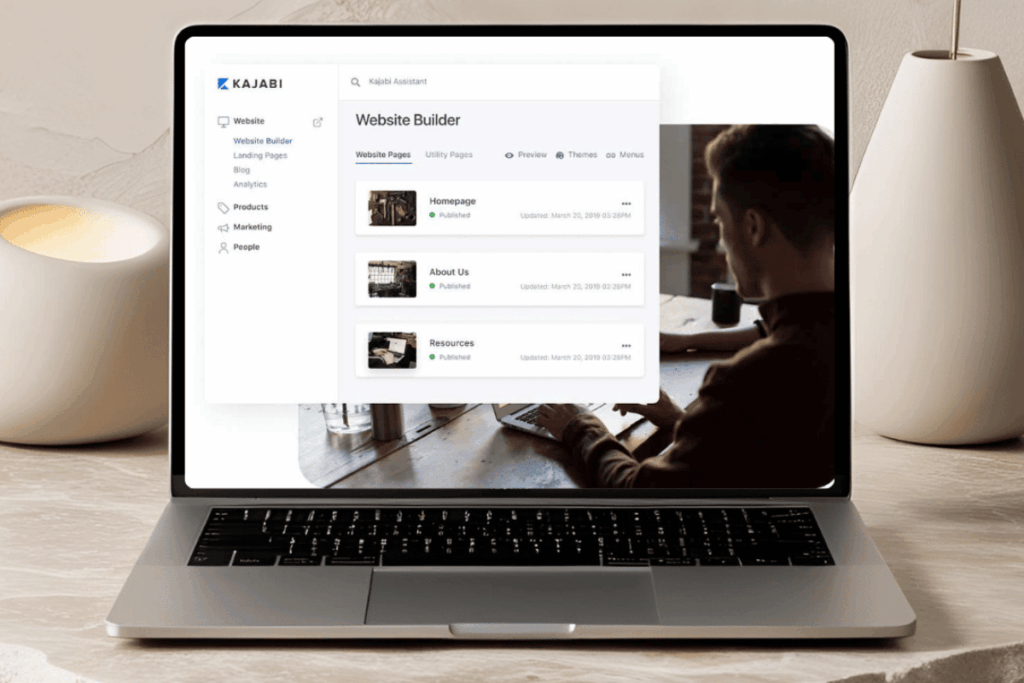
The builder is drag-and-drop, the backend is clean, and most clients feel comfortable making changes without needing support. In practice, we see people get confident with ThriveCart fairly quickly – especially when the setup is done properly from the start.
So ThriveCart vs Kajabi… Which Should You Choose in 2026?
By this point in the ThriveCart vs Kajabi conversation, most clients already know the answer, they just want permission to choose it.
The decision usually isn’t about features. It’s about how much complexity, cost, and fixed overhead makes sense for the stage of business they’re in right now.
Choose Kajabi if:
Kajabi still makes sense when:
- you want everything in one place and don’t want to manage integrations
- your offer is content-heavy, community-led, or membership-based
- students log in regularly and the learning environment is part of the value
- you’re happy paying a higher monthly fee for simplicity and peace of mind
In short: you’re consciously paying for convenience and you’re using enough of the platform to justify it.
Choose ThriveCart if:
ThriveCart is usually the better fit when:
- you already have a website and email marketing tool you like
- your offers are courses, coaching, or digital products
- you care about checkout pages, upsells, and conversion funnels
- You want to reduce fixed monthly costs
- you’d rather own your infrastructure than rent it
For many service-based businesses, this is the better return on investment, especially in a tighter economy.
A final thought (and where we come in)
If you’re questioning whether Kajabi is still worth the price, that’s usually not a software issue. It’s a systems one.
And the answer isn’t always “switch everything immediately”.
Sometimes it’s simplifying.
Sometimes it’s unbundling.
Sometimes it’s choosing tools that work harder for the business you have now, not the one you built two years ago.
That’s the lens we use with clients.
Whether you want help thinking it through, support moving platforms, or someone to set things up properly (Kajabi, ThriveCart, or something else entirely), that’s what we do.
If you want a second pair of eyes on your setup, get in touch or book a consult. We’ll help you make a decision you can actually live with and build the systems to support it.
on instagram